One of the most consequential structural shifts in modern business has unfolded so gradually that many organizations no longer recognize it as such.
Over time, especially across B2B technology companies, SaaS firms, PE-backed organizations, and increasingly revenue-pressured enterprises, the operational language of growth became progressively compressed into the language of pipeline.
Pipeline became the organizing framework through which executive teams interpret commercial health, evaluate marketing effectiveness, prioritize investment decisions, measure organizational performance, and govern growth accountability. Revenue meetings revolve around it. Board discussions increasingly revolve around it. Forecasting systems revolve around it. RevOps infrastructure revolves around it. Marketing planning often revolves around it. Entire go-to-market organizations now structure operational legitimacy around the ability to demonstrate measurable contribution to pipeline acceleration.
This transition did not occur because organizations suddenly became irrational or strategically careless. In many ways, the opposite happened. Modern organizations became more operationally sophisticated, more measurable, more accountable, and more coordinated than at any prior point in commercial history. As growth systems became increasingly complex, executives sought mechanisms to create visibility across fragmented customer acquisition environments. Pipeline provided that visibility. It translated messy commercial activity into structured operational movement that leadership teams could monitor, forecast, optimize, and report with increasing precision.
That operational clarity became extraordinarily valuable in environments shaped by investor pressure, quarterly performance expectations, rising acquisition costs, expanding martech ecosystems, attribution demands, and increasingly volatile growth conditions.
Under those pressures, pipeline evolved from a useful operational coordination mechanism into something much larger. It gradually became the dominant definition of growth itself.
"Once pipeline becomes the primary lens through which growth is interpreted, the organization begins reorganizing itself around the acceleration of revenue movement rather than the intentional shaping of long-term market conditions."
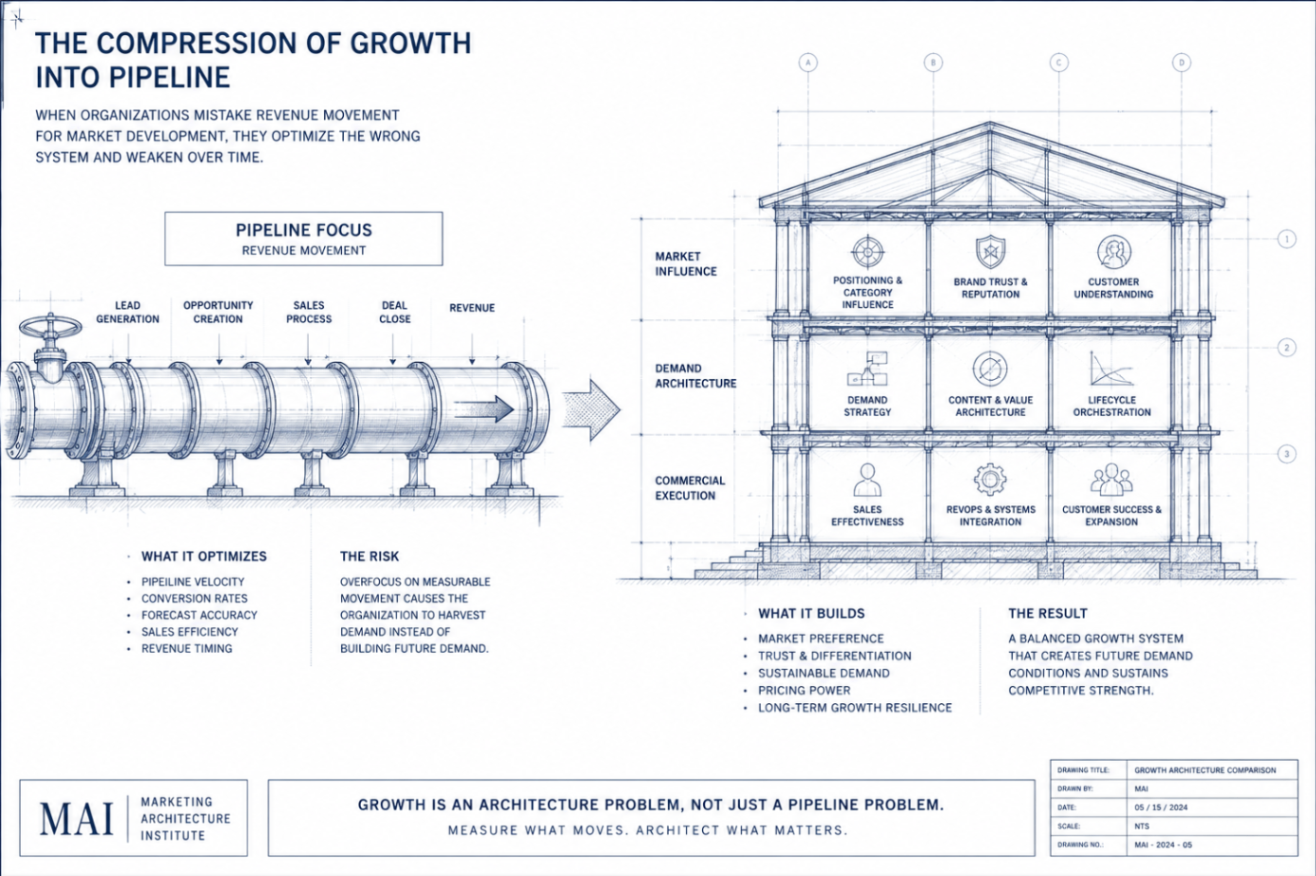
Pipeline Measures Revenue Movement, Not the Full Architecture of Growth
Pipeline is extraordinarily valuable operationally. Organizations absolutely require visibility into opportunity progression, sales velocity, conversion behavior, acquisition efficiency, forecast reliability, lifecycle movement, and revenue timing. Without these systems, modern enterprises struggle to coordinate commercial execution effectively.
Pipeline solves real organizational problems. But organizations increasingly make a dangerous interpretive leap once pipeline systems mature institutionally. They begin confusing the measurement of revenue movement with the governance of growth itself. Those are not equivalent concepts.
Pipeline primarily measures the progression of identified commercial demand through transactional systems already in motion. But the pipeline alone cannot fully explain the deeper strategic forces that shape whether future demand conditions strengthen or weaken over time.
Pipeline does not independently explain why customers trust one company more than another, why strategic differentiation erodes, why categories commoditize, why acquisition costs rise structurally, why pricing power weakens, or why markets gradually reinterpret the value of an organization over time.
Those dynamics emerge from systems operating upstream from pipeline visibility itself. Strategic positioning operates upstream from pipeline. Trust formation operates upstream from pipeline. Category influence operates upstream from pipeline. Brand memory operates upstream from pipeline. Demand architecture operates upstream from pipeline.
These systems shape the conditions under which future opportunities become more or less likely long before customers ever enter measurable sales infrastructure. Once organizations begin governing growth primarily through pipeline visibility, however, they naturally prioritize the systems most directly connected to measurable commercial movement — not because leadership consciously rejects strategic growth thinking, but because operationally visible systems gradually become the dominant mechanisms through which executive legitimacy, investment protection, and organizational accountability are determined.
The Compression Happens Through Operational Legitimacy
One of the reasons this transition remains difficult for organizations to diagnose accurately is because the compression of growth into pipeline rarely occurs through explicit executive strategy. No leadership team announces that the organization intends to reduce strategic growth architecture into conversion mechanics. The shift occurs indirectly through operational systems that progressively redefine which activities are deemed legitimate within executive environments.
Organizations optimize toward what leadership can operationally see, measure, defend, and report with confidence. This principle becomes especially powerful during periods of economic uncertainty or investor pressure because executives naturally gravitate toward systems that provide immediate clarity on commercial performance.
As these systems mature institutionally, they begin influencing how organizations evaluate virtually every growth investment. Marketing increasingly must justify itself through pipeline contribution. Brand investment increasingly requires attribution visibility. Content strategy increasingly becomes tied to conversion performance. Long-term market education becomes difficult to defend unless immediate commercial outcomes can be operationally demonstrated.
The problem emerges when organizations slowly lose the ability to distinguish between systems that extract value from existing demand, and systems that shape future market demand itself. Many of the most strategically valuable growth systems operate through delayed compounding effects rather than immediate transactional outcomes. Pipeline frequently captures downstream consequences after strategic conditions have already changed upstream — meaning organizations often misinterpret pipeline acceleration as the source of growth, when it may actually be the downstream result of strategic systems architected years earlier.
"Many organizations become increasingly extraction-oriented while weakening the systems that sustain durable market strength over time."
Organizations Gradually Shift From Demand Creation to Demand Harvesting
Once the pipeline becomes the dominant governing framework for growth, organizations begin reallocating attention to accelerating measurable commercial movement rather than intentionally shaping future market conditions. The shift is gradual but profound. Marketing increasingly becomes evaluated through lead generation, conversion support, acquisition efficiency, pipeline acceleration, and campaign attribution.
Over time, the organization begins to behave less like a company architecting long-term market influence and more like one optimizing the extraction of revenue from existing demand conditions. Initially, this often appears highly successful operationally. The organization becomes more measurable, more coordinated, more accountable, more operationally disciplined, and more commercially efficient.
In reality, many organizations become increasingly extraction-oriented while weakening the systems that sustain durable market strength over time. Eventually, symptoms begin emerging that operational optimization alone cannot fully resolve: acquisition costs rise despite stronger attribution systems, differentiation weakens despite increased marketing activity, customer trust fragments despite heavier engagement efforts, pricing pressure intensifies despite improved sales execution, and growth becomes increasingly volatile despite better dashboards than ever before.
At that point, organizations frequently intensify the very systems contributing to the imbalance — more reporting, more attribution scrutiny, more conversion pressure, more pipeline accountability. The organization becomes increasingly sophisticated at processing demand while becoming progressively weaker at shaping demand. That is one of the central strategic paradoxes emerging across modern growth organizations.
Marketing Becomes Vulnerable Because Its Highest-Value Contributions Compound Slowly
Marketing suffers disproportionately inside pipeline-dominant environments because many of its most strategically important contributions unfold through slower market effects that do not map cleanly into immediate attribution frameworks.
At its highest level, strategic marketing governs customer interpretation, strategic positioning, category framing, trust accumulation, market education, demand architecture, differentiation, and long-term preference formation. These systems profoundly influence revenue, but not always according to the timelines that operational revenue systems are designed to prioritize.
Markets do not reinterpret organizations instantly. Trust does not compound quarterly. Strategic differentiation does not emerge through isolated campaign cycles. Category authority does not develop through short-term conversion optimization alone.
When organizations evaluate Marketing primarily through immediate pipeline contribution, these slower-compounding systems gradually lose structural protection. Marketing then slowly compresses toward the subset of activities most operationally visible through revenue attribution systems: lead generation, campaign execution, nurture systems, acquisition support, and conversion enablement. These responsibilities matter enormously. But they do not represent the full strategic function Marketing historically played inside enterprise growth systems.
Once this compression occurs, organizations often continue performing well commercially for years because they are still benefiting from accumulated trust, historical positioning strength, existing customer preference, prior demand architecture, and previously established market credibility. The strategic erosion unfolds slowly beneath operational systems that continue to appear healthy in the short run.
Operational Sophistication Often Masks Strategic Weakness
One of the most dangerous aspects of pipeline-dominant organizations is that they often appear exceptionally mature commercially. They possess sophisticated RevOps infrastructure, advanced dashboards, mature attribution systems, detailed lifecycle visibility, highly instrumented funnels, and increasingly precise forecasting models. Operationally, these organizations often outperform competitors in measurable coordination.
But operational maturity and strategic maturity are not synonymous. An organization can become extraordinarily sophisticated at measuring revenue movement while simultaneously weakening the systems responsible for sustaining future market leverage over time.
This explains why some companies begin experiencing paradoxical conditions where reporting improves, operational discipline improves, forecasting improves, attribution improves, pipeline management improves — and yet differentiation weakens, acquisition costs rise, customer trust deteriorates, and pricing power erodes.
The organization interprets these problems operationally because pipeline has already become the dominant language through which growth is understood internally. What leadership often fails to recognize is that the underlying problem may not originate inside revenue movement systems at all. The weakening may originate upstream in the deterioration of strategic market architecture that pipeline systems were never designed to govern comprehensively in the first place. By the time the pipeline visibly weakens, the underlying strategic erosion has often begun years earlier.
"Growth is not synonymous with pipeline movement or revenue acceleration alone. Revenue movement reflects transactional outcomes. Growth reflects the strengthening of the organization's ability to shape market perception, sustain customer trust, and preserve strategic relevance over time."
Growth Is Larger Than Revenue Motion
One of the most important realizations modern organizations must recover is that growth is not synonymous with pipeline movement or revenue acceleration alone. Revenue movement reflects transactional outcomes. Growth reflects the strengthening of the organization's ability to shape market perception, sustain customer trust, influence demand conditions, maintain differentiation, command pricing authority, deepen customer preference, and preserve strategic relevance over time.
Pipeline visibility is an important operational layer inside this system. It is not the entire system. Organizations that mistake revenue movement for growth architecture eventually encounter strategic ceilings operational optimization alone cannot overcome.
Operational Requirements
- Forecasting discipline
- Lifecycle visibility
- Operational accountability
- Revenue coordination
- Measurable execution systems
Strategic Requirements
- Positioning governance
- Trust formation
- Customer understanding
- Market education
- Category influence
- Strategic differentiation
- Long-term demand architecture
Without those systems, organizations may continue to accelerate revenue operations for extended periods while quietly weakening structurally beneath the surface. Eventually, the market notices — but by then the organization often has more dashboards, more attribution models, and greater reporting sophistication than ever before. But far less strategic leverage than it once had.
Growth is an architecture problem, not just a pipeline problem. The organizations that recognize this distinction early — and govern both operational execution and strategic market architecture with equal intentionality — are the ones most likely to sustain competitive strength as complexity increases. Measure what moves. Architect what matters.
Bray Brockbank
Founder, Marketing Architecture Institute
Frequently Asked Questions
What does it mean to compress growth into pipeline?
Compressing growth into pipeline means organizations begin governing all commercial activity primarily through pipeline visibility — measuring revenue movement rather than the full architecture of growth, including trust formation, strategic positioning, category influence, and long-term demand conditions.
Why is pipeline-dominant governance a strategic risk?
Pipeline measures the progression of identified demand through transactional systems. It cannot explain why customers trust one company more than another, why differentiation erodes, or why acquisition costs rise structurally. Organizations that govern growth primarily through pipeline visibility gradually underinvest in the upstream systems that shape future demand.
What is the difference between demand creation and demand harvesting?
Demand creation involves intentionally shaping future market conditions through positioning, trust formation, category influence, and market education. Demand harvesting involves accelerating the extraction of revenue from existing demand. Pipeline-dominant organizations often become highly efficient at harvesting while progressively weakening their capacity to create future demand.
Why does marketing suffer most in pipeline-dominant environments?
Marketing's highest-value contributions — strategic positioning, trust accumulation, category authority, demand architecture — compound slowly and do not map cleanly into immediate attribution frameworks. In pipeline-dominant environments, these systems lose structural protection as they become difficult to defend within short-horizon commercial metrics.
What are the symptoms of a pipeline-dominant organization?
Common symptoms include rising acquisition costs despite stronger attribution systems, weakening differentiation despite increased marketing activity, intensifying pricing pressure despite improved sales execution, and growth volatility despite better dashboards. These conditions often emerge years after the underlying strategic erosion began.
How does operational sophistication mask strategic weakness?
Organizations can become extraordinarily sophisticated at measuring revenue movement while simultaneously weakening the systems responsible for sustaining future market leverage. Advanced dashboards, mature attribution systems, and precise forecasting models create the appearance of strategic maturity while strategic erosion unfolds beneath the surface.